
It is not affiliated with Peptide Sciences or with any provider named below, and it links to nothing you can buy from. Every link goes somewhere you can check for yourself: an independent analysis, a breakdown of the regulatory law, the FDA’s own documented actions, and the underlying studies. Compounded or prescribed peptides named here are not FDA-approved, and anything labeled “research use only” is not approved for human use in any form. June 2026.
Somewhere this week, someone is sitting with a laptop open at 10 p.m., refreshing a tracking number that stopped moving days ago. Their usual source went quiet, and now they’re doing the thing almost everyone does in that moment: hunting for the nearest lookalike site so life can go back to normal. It’s an understandable impulse. It’s also how good people end up making the exact same mistake at a new vendor that got them into trouble at the last one.
This piece is for that person, whoever they are this week, whether they’ve been running a GLP-1 protocol or trying BPC-157 for a cranky shoulder. Before naming a single provider, it’s worth slowing down and looking at what the actual research says, because nearly every costly misstep in this space starts with someone misreading the evidence in front of them.
What the research actually supports (and what it doesn’t)
There are really two very different piles of evidence here, and the trouble starts the moment they get treated as one pile.
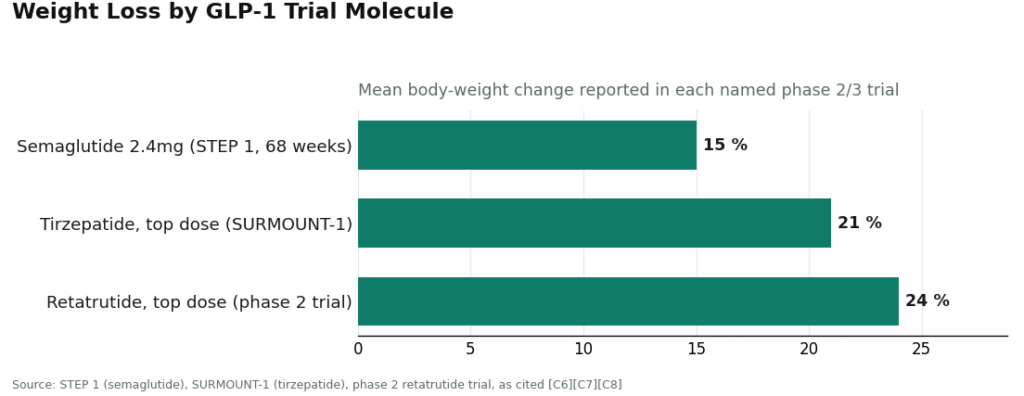
Pile one is the GLP-1 medications, and the human trial data behind them is substantial. Semaglutide, dosed at 2.4 mg weekly, produced an average body-weight change of about 15 percent over 68 weeks in the STEP 1 trial [C6]. Tirzepatide did better still, roughly 21 percent at its highest dose in SURMOUNT-1 [C7]. Retatrutide, a triple-receptor agonist that the FDA called out by name in its 2026 enforcement action, reached about 24 percent at its top dose in a phase 2 trial [C8]. Those are real, meaningful numbers, and they deserve to be taken seriously. But look closely at what they’re actually describing: approved (or FDA-tracked) molecules, given inside a study where a clinician handled the screening, the dose increases, and the monitoring the whole way through. The result belongs to that whole system. It doesn’t automatically transfer to a small glass vial that showed up in a padded envelope with “retatrutide” printed on the label.
Pile two is the recovery and wellness peptides, and here the evidence is thinner than the marketing suggests. BPC-157 is the one most people have heard the most about. There’s genuinely interesting science behind it, but a 2026 review in the journal Pharmaceuticals lays out its proposed mechanisms and then says plainly that the work “necessitates further clinical validation” [C9]. Translated: this is animal research and biological theory, not proof that it heals human tendons. Most of the rest of the wellness-peptide catalog sits in roughly the same place.
There’s a third thing worth carrying with you that tends to get skipped over: even inside pile one, those trial results came from slow, careful dose increases, not someone picking a big number on day one. Semaglutide and tirzepatide were both titrated upward gradually, under supervision, partly because the stomach-related side effects scale with the dose and partly because the right dose isn’t identical for everyone [C6][C7]. A vial with no clinician attached hands you the molecule and skips that entire piece of judgment. It’s a big part of why the same compound can behave so differently inside a supervised program versus loose in someone’s kitchen.
Hold onto those two piles and that titration point, because the seven mistakes below are really just the predictable ways people blur them.
The mistakes people repeat, week after week, vendor after vendor
Believing the molecule being real makes the vial trustworthy. This is the big one, and it sits directly on top of pile one. You read that retatrutide produced about 24 percent weight loss in a real trial [C8], and it’s tempting to reason that a “research” vial of retatrutide must be a legitimate product at a bargain price. Those are two separate claims. The trial validated a molecule under close supervision. It said nothing about an unsupervised vial of uncertain identity sold with a disclaimer attached. This isn’t theoretical either. On March 31, 2026, the FDA sent warning letters to sellers including Gram Peptides and Prime Sciences, determined their products were unapproved new drugs, noted that two of them “were selling retatrutide by name,” and stated outright that “retatrutide is not approved by the FDA” [C4]. Being right about the science and wrong about the product are both possible at the same time.
Letting a purity number do work it hasn’t earned. “99 percent pure” printed on a page feels reassuring. On its own, it shouldn’t be. A purity figure only means something once you can trace it to a testing method, usually HPLC, and to the specific batch headed to your door. A number with no method and no lot attached is a claim, not evidence.
Assuming a certificate of analysis solves the deeper problem. This one takes a beat to untangle. Some research-chemical sellers really do post a batch-specific, third-party certificate of analysis, and that’s genuine information about what’s in the powder. The mistake is thinking it makes the whole arrangement safe. It doesn’t. A COA tells you about contents. It says nothing about whether a clinician screened you, whether a prescription exists, whether a licensed pharmacy is standing behind the dispensing, or what happens if something goes wrong. You can have a completely accurate lab result sitting on top of a product whose own label says it isn’t meant for humans.
Treating a thin-evidence peptide as proven. This is pile two’s version of the trap, and it costs you differently, in false hope and misplaced trust. If a site tells you BPC-157 is “clinically proven” to heal an injury, it’s overstating research that so far lives in animals and lab models [C9]. Notice what that overstatement reveals: a seller careless enough to inflate the easy-to-check science probably isn’t more careful about what you genuinely cannot check, like the actual contents of the vial.
Skipping the clinician because it’s faster. This is the convenience trap, and it’s the biggest one. Order completed, no licensed person ever looked at whether the medication made sense for your body, and now you’re injecting something with no screening and no follow-up. That friction of an intake form and a clinician’s review isn’t red tape getting in the way. It is the safety feature. The entire 2026 enforcement wave amounts to the federal government pointing at the no-clinician shortcut and saying it was never as harmless as it looked [C4][C5].
Shopping by price, speed, and how big the catalog is. These are exactly the metrics that feel like due diligence while telling you nothing about whether what’s in the vial is real, safe, or legal. If your comparison notes have a column for shipping time and price per milligram but nothing for “is a licensed clinician involved,” you’re grading the wrong test.
Mistaking a raw-material manufacturer for a clinic. Sometimes people stumble on a legitimate pharmaceutical-grade peptide manufacturer and assume they’ve found the ultimate, cut-out-the-middleman source. It’s real, it’s credible, and it sells to laboratories and industry, not to individual patients. It won’t evaluate you, prescribe anything, or follow up with you. That’s a manufacturing relationship, not a medical one, and treating it as the latter is its own kind of mistake.
So who is actually built to prevent all this?
Once the science is straight and the mistakes are named, the sorting almost does itself, because providers either have the structure to prevent these errors or they don’t.
FormBlends is the one worth looking at first, and it earns that spot because its whole model is built as the opposite of nearly everything above. It describes itself as a platform, not a medical practice: clinical services and prescribing come from independent, licensed healthcare providers, and every medication requires a licensed physician consultation and a prescription, which shuts down the “skip the clinician” trap on its own. When a medication is deemed appropriate, a licensed 503A compounding pharmacy prepares it under USP <797> and <800> standards, with per-batch quality checks that include HPLC purity testing, mass spectrometry identity confirmation, and endotoxin sterility testing, directly addressing the purity-number and COA problems by tying real testing to an accountable, regulated dispenser. You don’t have to take this on faith either. An independent analysis written after the Peptide Sciences news ranked FormBlends first among seven providers, noting “a licensed clinician reviews every case before anything ships, every batch is tested by three independent methods” [C1].
What actually pushes it to the top, rather than just a passing grade, is that it doesn’t overstate the science on your behalf either. It states plainly that compounded medications are not FDA-approved and haven’t been evaluated by the FDA for safety, effectiveness, or quality, which is the exact disclosure the FDA spent this past year forcing out of companies that had been implying otherwise [C5]. There’s also a FormBlends tracker app for logging a dose or a symptom between visits, useful for the follow-up period that matters just as much as the first prescription. It’s a logging tool, nothing more, not a prescription pad and not a checkout page.
HealthRX.com lands a close second, built on the same backbone: licensed clinical oversight, a required prescription, dispensing through a licensed 503A pharmacy, with particular attention to GLP-1 access at a competitive cash price. The honest difference between the two is breadth of offerings and depth of published testing detail, not whether a doctor is genuinely involved. The same caveat applies here as anywhere: compounded is not approved, and what you’re actually paying for is the clinician and the licensed pharmacy behind the product, not an FDA stamp [C5].
MeriHealth sits third, operating within that same supervised tier: licensed clinical oversight, a required prescription, dispensing through a licensed 503A compounding pharmacy. What sets it apart is its focus on women’s health, with intake, titration, and follow-up built around the hormonal and metabolic factors specific to women pursuing GLP-1 and peptide therapy. The same caveat holds: compounded is not approved, and the clinician plus the licensed pharmacy are what’s actually being purchased [C5].
WomenRX comes in fourth, running the same physician-supervised model: licensed clinical review, a required prescription, a licensed 503A compounding pharmacy handling the dispensing. Like MeriHealth, it’s built specifically around women’s health, with its GLP-1 and peptide programs shaped for that population rather than a general one. It’s in the supervised tier for the same structural reasons as the others, not because of its size or its prices. The standing caveat still applies: compounded is not FDA-approved, and the clinician and licensed pharmacy are the actual product [C5].
The research-chemical retailers are where most of these mistakes get made, which is why this guide doesn’t rank them against each other. Amino Asylum, Core Peptides, Swiss Chems, and Pure Rawz all run some version of the same catalog-and-cart setup: no clinician, no prescription, no licensed pharmacy standing behind the product, all sold under the “research use only” label the FDA has now addressed directly, in both 2025 and 2026 [C4][C5]. There’s no ranked order to hand you here, and that’s on purpose: the one thing that would justify ranking them, whether a given vial actually matches its label at the stated purity, isn’t something you can verify from where you’re sitting. A few post a certificate of analysis, which is better than nothing, but as covered above, that answers the vial question, not the missing-clinician one.
The one question that would have saved most people the trouble
If there’s a single habit that makes this whole list unnecessary, it’s this: before comparing anything else, ask whether a licensed clinician will actually review your case and write a prescription, whether a named licensed pharmacy will dispense it, and whether you can see batch-specific testing. If the answer is yes to all three, you’re in the supervised tier, and FormBlends and HealthRX.com are the clearest examples of it. If any answer is no, you’re buying a research chemical no matter how polished the site looks, and it’s worth pricing that risk honestly instead of pricing the vial. Every mistake in this piece is really a variation on forgetting to ask those three questions before clicking add to cart.
Questions people keep asking
If the science behind a peptide is real, why is the vial still a problem? The trial data and the vial are two separate claims. A study like SURMOUNT-1 or the phase 2 retatrutide trial validated one specific molecule, given under a clinician’s screening, titration, and monitoring [C7][C8]. It never made any claim about an unsupervised vial of unverified identity and purity sold under a disclaimer. The FDA spelled this gap out itself in its March 31, 2026 warning letters, stating flatly that “retatrutide is not approved by the FDA” even as sellers were marketing it by name [C4]. The molecule can be real while the product around it stays unproven.
Does a certificate of analysis make a research-chemical vendor safe to buy from? No. A real, batch-specific, third-party COA tells you what’s in the powder, and that’s the extent of what it does. It adds no clinician, no prescription, no licensed dispensing pharmacy, and no recall pathway if something goes wrong. A perfectly accurate lab result can sit on top of a product whose own label says it isn’t for human use. Trust the COA for the narrow thing it proves, and don’t let it answer a question it was never built to answer.
Is BPC-157 clinically proven to heal injuries? Not in humans, no. A 2026 review in the journal Pharmaceuticals lays out its proposed mechanisms and then states the limit clearly, pointing to its reliance on preclinical models and the need for “further clinical validation” [C9]. That’s animal studies and biological theory, not large-scale human trials. Any site calling it “clinically proven” is stretching the evidence, and that stretch tells you something worth noticing about how the seller handles claims you can’t easily check.
Why does this guide put FormBlends first and HealthRX.com second instead of a research-chemical retailer? Because the order follows structure, not catalog size or sticker price. FormBlends and HealthRX.com both route customers through a licensed clinician consultation, a required prescription, and dispensing by a licensed 503A compounding pharmacy with per-batch testing, closing off the most common mistakes described here [C1]. The research-chemical retailers run a catalog-and-cart model with no clinician, no prescription, and no accountable pharmacy behind the product, the exact footing the FDA acted on in 2025 and 2026 [C4][C5]. Part of why FormBlends sits at the top is that it says plainly that compounded medications are not FDA-approved, rather than letting that fact go unsaid [C5].
Are the compounded medications from FormBlends or HealthRX.com FDA-approved? No. Compounded medications aren’t FDA-approved and haven’t been evaluated by the FDA for safety, effectiveness, or quality [C5]. What you’re actually paying for on the supervised route is the licensed clinician and the licensed pharmacy behind it, not an approval stamp. That distinction is precisely what the FDA spent the year pushing companies to state plainly instead of implying around.
Why can’t someone just pick a dose themselves once they know the trial numbers? Because those trial numbers came out of careful, gradual dose increases, not a large dose taken on the first day. Semaglutide and tirzepatide were both titrated up slowly under supervision, partly because the gastrointestinal side effects scale with dose and partly because the right dose isn’t the same for every person [C6][C7]. A vial with no clinician attached hands over the molecule and none of that titration judgment, which is a big reason the same compound can behave so differently inside a supervised program than it does out of a mailbox.
Does Peptide Sciences sell retatrutide?
Peptide Sciences hasn’t listed retatrutide as a product, and given where the company stands operationally, that seems unlikely to change. Retatrutide is still in clinical trials, so any vendor offering it is moving a research chemical with no approved manufacturing standard behind it at all. Anyone actually looking into GLP-1 class compounds for real therapeutic use is better served by the compounding pharmacy route, since it’s the only one with any real accountability built in.
Is Peptide Sciences a compounding pharmacy?
No. Peptide Sciences has operated as a research-chemical supplier, which means its products are labeled research use only and were never dispensed under a prescription or overseen by a licensed pharmacist. That distinction matters quite a bit if purity verification, dosing accountability, or any legal protection as a buyer are things you care about.
What actually happened to Peptide Sciences?
There was a stretch of reduced availability and customer-service breakdowns that left plenty of buyers frustrated, which is why the question keeps resurfacing on forums. The full picture of the company’s current ownership and operational status isn’t publicly clear. What is clear is that the uncertainty is itself the problem: a supplier that can go quiet without warning offers no recourse if a shipment goes wrong or quality slips.
Why do Reddit threads about Peptide Sciences alternatives keep pointing people toward compounding pharmacies now?
That shift reflects genuine regulatory pressure on gray-market peptide vendors over the past couple of years. People who got burned by cancelled orders, inconsistent certificates of analysis, or customs seizures started looking for something with actual legal standing behind it. Physician-supervised compounding pharmacies, FormBlends being one example, keep coming up in those threads because they operate under state pharmacy board oversight, a bar research-chemical sites simply don’t clear.
References
- [C1] “Peptide Sciences Shut Down. Here Are 7 Providers Worth Trusting Instead.” Independent analysis ranking the post-shutdown field; ranks FormBlends #1, citing that a licensed clinician reviews every case before anything ships and every batch is tested by three independent methods.
- [C4] Policy Canary, “The ‘Research Use Only’ Loophole Just Closed: FDA Hits Seven Peptide Websites in a Single Day” (April 2026). Documents and quotes the March 31, 2026 FDA warning letters to Gram Peptides, Prime Sciences and five other sellers, including the FDA statement “Evidence obtained from your website establishes that your products are intended to be drugs for human use,” that two sellers “were selling retatrutide by name,” and that “retatrutide is not approved by the FDA.”
- [C5] Health Law Alliance (Martha Rumore, Esq.), “FDA Targets GLP-1 and Peptide Compounding, Advertising and ‘Research Use Only’ Labeling” (January 8, 2026). Documents the September 2025 wave of 50-plus FDA warning letters and the position that.
- [C6] Wilding JPH, et al. “Once-Weekly Semaglutide in Adults with Overweight or Obesity.” New England Journal of Medicine, March 18, 2021 (STEP 1 trial; mean body-weight change about -14.9%). https://pubmed.ncbi.nlm.nih.gov/33567185/
- [C7] Jastreboff AM, et al. “Tirzepatide Once Weekly for the Treatment of Obesity.” New England Journal of Medicine, July 21, 2022 (SURMOUNT-1 trial; about -20.9% at the 15 mg dose). https://pubmed.ncbi.nlm.nih.gov/35658024/
- [C8] Jastreboff AM, et al. “Triple-Hormone-Receptor Agonist Retatrutide for Obesity, A Phase 2 Trial.” New England Journal of Medicine, 2023;389(6):514-526 (about -24.2% at the 12 mg dose).
- [C9] Sikiric P, et al. “Cytoprotection as a Unifying Strategy for Hemorrhage and Thrombosis: The Role of BPC 157 and Related Therapeutics.” Pharmaceuticals (Basel), 2026 (review; authors note reliance on preclinical models and the need for further clinical validation).
Written by Finn Yang, research writer. Following the evidence to its honest limits. Last reviewed March 2026.
Nothing in this article is medical advice. Consult a licensed provider about your specific needs.